
Rainbet information for adults in the UK
Rainbet Originals and Provably Fair Verification Explained
 Available in GB
Rainbet terms, 27 September 2026: Rainbet publishes Original games including Plinko, Dice, Limbo and Mines, alongside an operator-described method for checking individual outcomes with a server seed, hashed server seed, client seed and nonce. The important distinction is between verifying a recorded result and independently certifying an entire casino. A successful result check addresses a particular round under the published method; the check is limited to that recorded round and says nothing about country eligibility, supplier-wide mechanics or risk-free play. Clause 4.1.3 of Rainbet’s current general Terms explicitly restricts residents of, and access from, the United Kingdom of Great Britain and Northern Ireland. The published restriction remains controlling for UK access.
The operator’s Provably Fair help article provides the primary description of its Original verification records. It says past bet details can be examined and an outcome checked after the seed is rotated. That sequence is useful evidence of the claimed mechanism, but it is not a substitute for a complete third-party audit, consumer-protection review or jurisdictional permission.
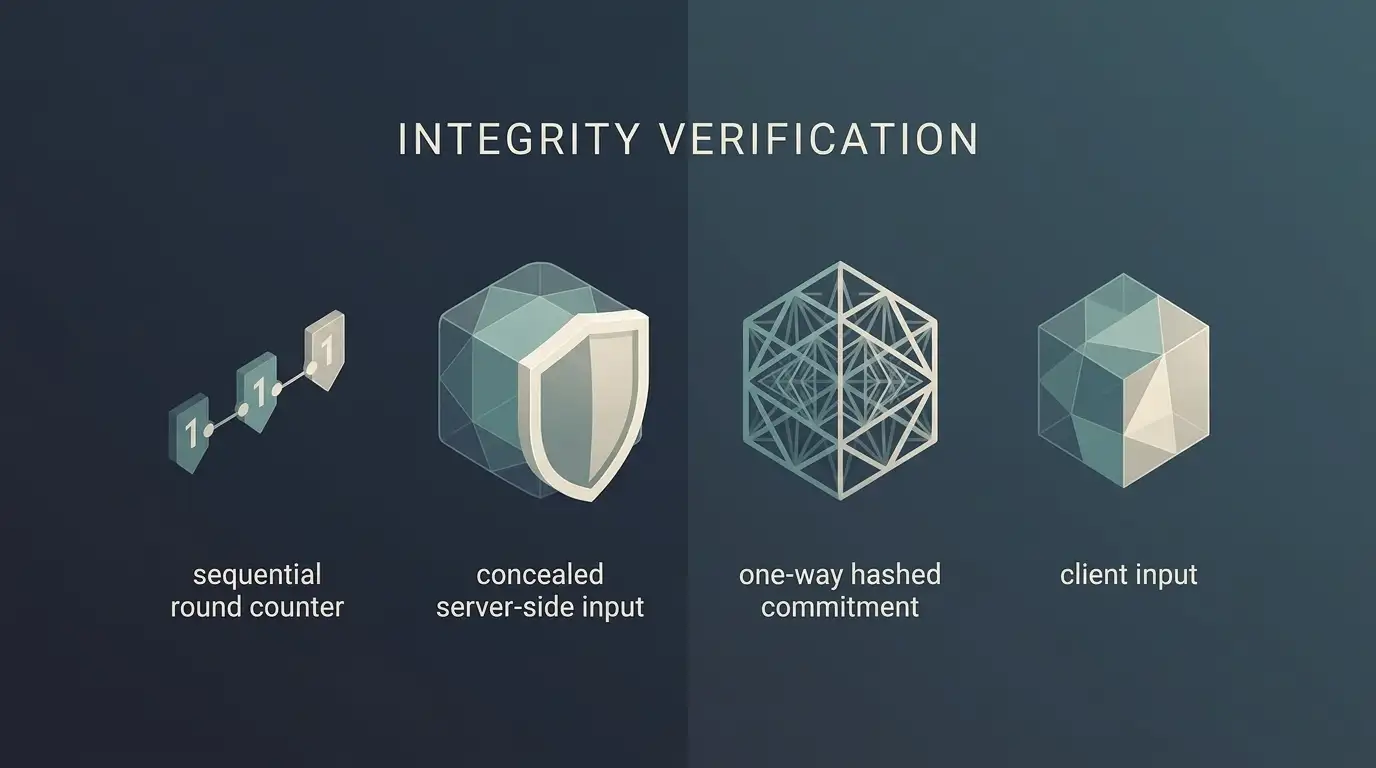
Table of Contents
- What belongs to the Originals category?
- The four recorded inputs, in plain English
- What the official result-checking sequence establishes
- Commitment, revealed seed and calculated outcome
- Historical outcomes and round records
- Provider games are a separate technical claim
- What provably fair cannot settle
- Originals, third-party games and access are distinct
- Frequently asked questions
What belongs to the Originals category?
Originals are custom games presented as a distinct part of Rainbet’s global catalogue. Independent coverage corroborates this category and its verification claims. Named examples in the checked source record are Plinko, Dice, Limbo and Mines. These are examples, not a claim about the total number of Originals available on a particular date, at a particular account or in a particular country.
The names refer to different presentations: Plinko uses a ball-drop format, Dice uses a numbered outcome, Limbo uses a target multiplier and Mines uses a concealed-field format. They do not have identical rules merely because an Original may use a common result record. The category names alone establish no title-specific odds, return or house-edge percentage.
The game library overview separates Originals from third-party slots, live-dealer tables and sports betting. That separation prevents a claim about one group from being applied indiscriminately to another. The operator’s help article makes a separate statement about provider games, whose fairness processes are managed by the providers themselves.
The four recorded inputs, in plain English
The official help article identifies four data items on the fairness view. They are not four separate promises of a good result; together they form a record against which a historical outcome can be checked. Understanding their roles is more useful than treating the label “provably fair” as a badge that needs no further questions.
| Field | Function in the published record | Common misunderstanding |
|---|---|---|
| Server seed | An operator-side input whose relevant value is revealed for retrospective checking after rotation. | Assuming a hidden seed can be examined in advance merely because its hash is visible. |
| Hashed server seed | A one-way cryptographic representation that can commit the operator to the underlying seed value before its later disclosure. | Treating a hash as the complete secret seed or as a regulator’s certificate. |
| Client seed | A second input associated with the recorded outcome calculation. | Assuming that merely supplying another input removes the house edge. |
| Nonce | A round-related counter used to distinguish outcomes generated under a seed pair. | Confusing a counter with a winning probability or a monetary balance. |
A hash can be compared with a later disclosed seed to see whether the commitment and reveal correspond, provided the appropriate algorithm is known. A nonce gives different rounds distinct input records, so a verifier does not confuse one historical round with another. The client seed contributes an additional input. None of these fields independently proves that the displayed paytable is economically favourable, that there are no software defects or that the operator has enough funds to pay everyone.
What the official result-checking sequence establishes
The help page, published 27 May 2026, describes the operator’s process. It identifies bet details containing the four named fields, says the seed must first be rotated for verification, and describes an Original game’s fairness view accepting the recorded details to show an outcome. It also says seed rotation cannot occur while a game is active. Here these are details of the source’s audit trail, not instructions for a UK resident to sign in, wager or bypass the published restriction.
- A prior result exists: the subject is an already recorded round, with the appropriate historical bet details. An image of a game without the relevant round details does not establish a reproducible outcome.
- A commitment exists: the hashed server seed provides a checkable representation of the operator-side seed from the earlier state. The distinction between the earlier commitment and later revealed value matters.
- The prior seed is revealed after rotation: the published method requires rotation before the historical seed can be used in a retrospective check. A hash by itself cannot be treated as that revealed value.
- The record is matched: server seed, hash, client seed and nonce belong to the same historical round. Mixing records from different rounds can create an apparent mismatch that says nothing useful about the actual result.
- The result is reproduced: the operator’s documented verification view displays the calculation’s outcome from the supplied details. The comparison concerns that exact round.
The four recorded values and relevant round details allow an outcome to be considered within the published procedure. A generic picture of a game without the actual round data cannot reproduce that calculation. Independent testing of an implementation is a separate claim from an operator-provided mechanism.
Commitment, revealed seed and calculated outcome
A helpful way to read a fairness claim is to separate three moments. At commitment, a hash is available but the private seed is not yet disclosed. At reveal, the earlier seed becomes available for the relevant completed sequence. At comparison, the historical result is checked using the disclosed inputs. Conflating these moments is a common mistake. Revealing a seed before its commitment would not establish that the operator was bound to it earlier; quoting a hash without a later matching reveal would leave the comparison incomplete.
A historical calculation using seeds and a nonce addresses an individual outcome. It is not an independent certificate for every part of the game’s software. The operator’s help page explains the on-platform procedure; an external certification claim would require separate details about the implementation, scope and auditor. No auditor, certificate number or universal return figure follows from the four data fields alone.
Even when a recorded result can be reproduced, the original stake, game rules and displayed outcome remain separate evidence. A correct calculation can still belong to a game with an unfavourable expected return. Cryptographic repeatability is about the relationship between inputs and a stated result, not a guarantee that playing more will improve anyone’s finances.
Historical outcomes and round records
For a documented historical-round dispute, the critical questions are whether the claimed result is tied to one identifiable round, whether the earlier hash is preserved, whether the later disclosed server seed matches that commitment, and whether the paired client seed and nonce correspond to that same round. Those questions describe the quality of evidence rather than telling anyone to open an account. A title and approximate time do not provide the full record.
A mismatch could reflect a transcription error, a different input or an implementation issue. It should be documented rather than turned instantly into a sweeping statement about all games. Conversely, a match for one historical round should not be advertised as independent approval of an entire catalogue. Both extremes overstate what a single observation supports.
Keep the operator’s explanation distinct from third-party observations and inference. The current Rainbet help article is direct evidence that a procedure is published; it is not a report from an external testing laboratory. A careful review can say exactly that without either dismissing the procedure or inflating its scope.
Provider games are a separate technical claim
Rainbet’s official help page has a section for third-party provider games. It says those providers manage their own systems and that the operator does not control their separate processes. The section also describes seed-related assistance for provider gameplay, but does not establish that every third-party game presents the same four-field Original verification view or exposes an identical calculation. A provider’s published testing or game-specific documentation is needed for provider-specific claims.
That distinction matters when a review mentions a famous slot studio next to a Rainbet Original. A studio-built title and a custom Original can share a lobby without sharing verification mechanics. A supplier logo or generic “fair” label cannot identify the algorithm, data record or external testing that applies to an individual title. The most informative question is: which system generates this exact game’s outcomes, and what evidence is available for that system?
What provably fair cannot settle
- Expected return: recreating a round is not a claim that the game has no house advantage or that any individual will recover losses.
- Software and operational controls: one checked result is not an exhaustive security, code or financial audit.
- Player eligibility: a technically checkable outcome does not override an operator’s territory restrictions or licensing obligations.
- Cash handling: the fairness record does not establish that withdrawal conditions have been satisfied or that payment rails work in a particular jurisdiction.
- Independent regulation: the label is not interchangeable with a UKGC licence record, dispute scheme membership or statutory safeguards.
Rainbet also describes self-exclusion in its responsible-gambling help material. That is a separate account-protection topic, not an attribute conferred by the seed calculation. For the distinction between its stated Anjouan jurisdiction and the separate Great Britain licensing framework, read the Rainbet licence and UK rules. Neither source should be stretched to imply a verified UK service entitlement.
Originals, third-party games and access are distinct
| Source | What it establishes | What it does not establish |
|---|---|---|
| Rainbet Provably Fair article | The operator’s four named inputs, rotation condition and historical verification view. | An independent test of every production round or a UK account entitlement. |
| Independent Rainbet product overview | The existence of the global Originals category alongside other games. | A fixed catalogue count or authoritative game-specific maths. |
| General Terms, clause 4.1.3 | The current general restriction covering UK residence and access. | The quality of a particular result-checking algorithm. |
For Rainbet Originals, the published method links a stored commitment, a revealed server seed, the client seed and a nonce to a past outcome. Independent provider games have their own rules and technical arrangements. Neither a historical result calculation nor a catalogue description changes the UK access restrictions. The full Rainbet review puts the games in their wider product context.
Frequently asked questions
Does “provably fair” mean there is no house edge?
No. It concerns checking an outcome under a stated method. The mathematical return and the rules of a particular game are separate questions. A matching historical result cannot make a gambling result financially safe.
Is the hashed server seed the same as the revealed seed?
No. The hash is a representation used for a prior commitment; the disclosed seed is the value that can later be checked against it. The distinction is central to understanding why the verification record has more than one server-side field.
Are provider slots verified with the same Rainbet Original view?
The official article distinguishes provider-managed systems from Originals. Its Original process should not be presented as proof that every supplier offers an identical interface or calculation.
Does this make Rainbet available to a UK resident?
No. Its current general Terms name the United Kingdom of Great Britain and Northern Ireland in clause 4.1.3. A product feature does not amend that provision. The complaints and player safeguards section covers the related Rainbet context.
Written by the editors at Rainbet Casino.